
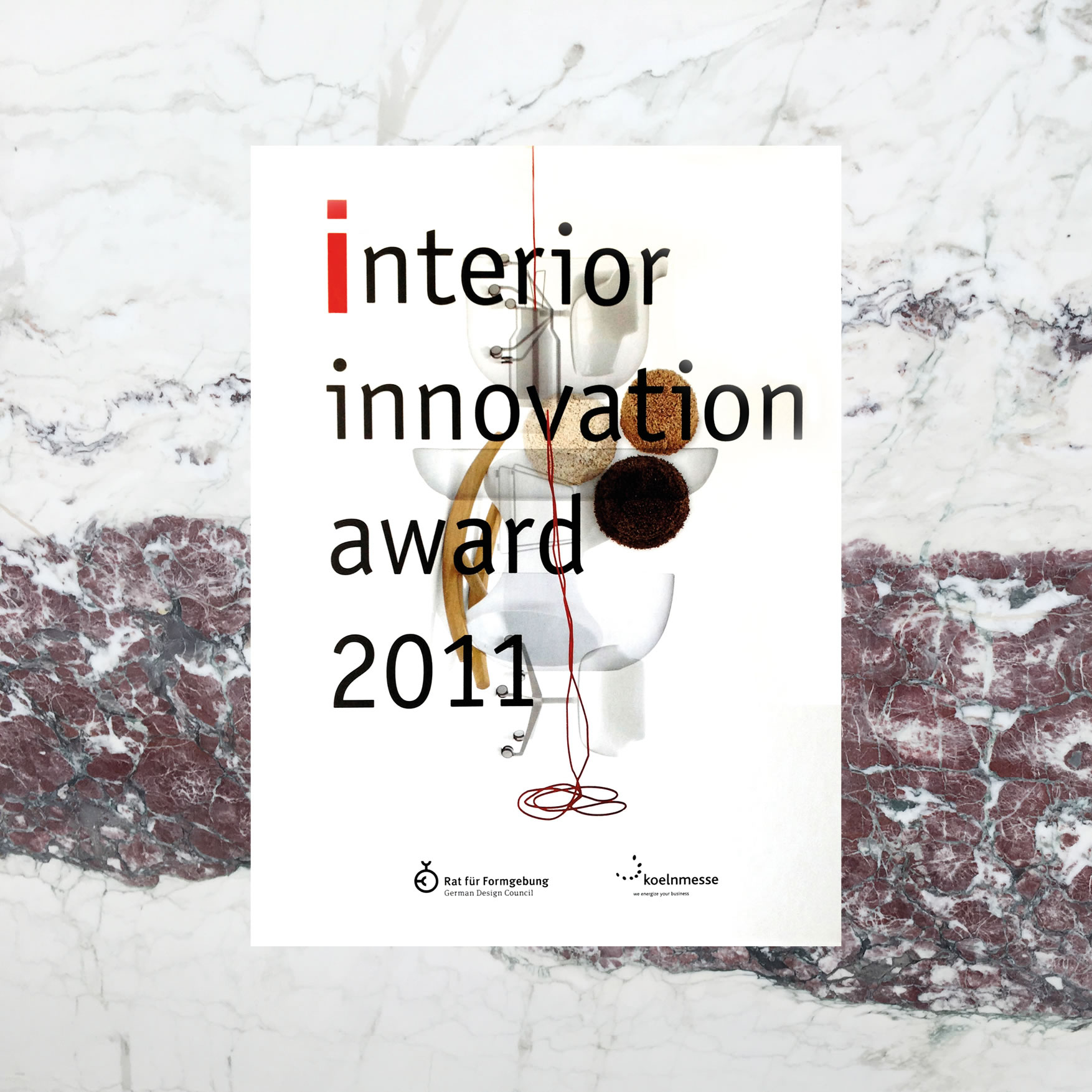
Interior Innovation Award 2011
Book
The award of the Interior Innovation Award in 2011 marked an early international reference point within the work of Felix Schwake. What was recognised was less a decorative style than a consistently pursued attitude toward architecture, design, and use.
At the centre of the work is the question of how function, material, and spatial atmosphere can be translated into a clear geometric order. The designs consciously move between architecture, furniture, and functional art. They are not intended solely to be observed, but to structure everyday life and influence spatial perception.
The design follows a reduced formal language. Superfluous elements are removed in order to bring material, proportion, and use to the foreground. Functions are fully integrated so that the objects appear calm and self-evident. The reduction does not serve an end in itself, but creates concentration, clarity, and a heightened awareness of space.
The term “functional art” in this context does not describe a separation between art and use, but their shared foundation. Furniture and spaces emerge from the same responsibility toward use, atmosphere, and permanence.
In architecture as well, the work follows the same principles. Spaces are not understood as visual staging, but as a background for human action, perception, and life. Architecture has a lasting influence on behaviour and therefore carries responsibility beyond its pure function.
The distinction through the Interior Innovation Award also points to an international discourse on reduced and material-oriented design that consciously positions itself against short-lived stylistic trends. The focus is not on decorative effects, but on how design is used, experienced, and perceived over time.
The work of Felix Schwake therefore does not attempt to merge art and design, but to make visible their shared spatial and cultural responsibility.