
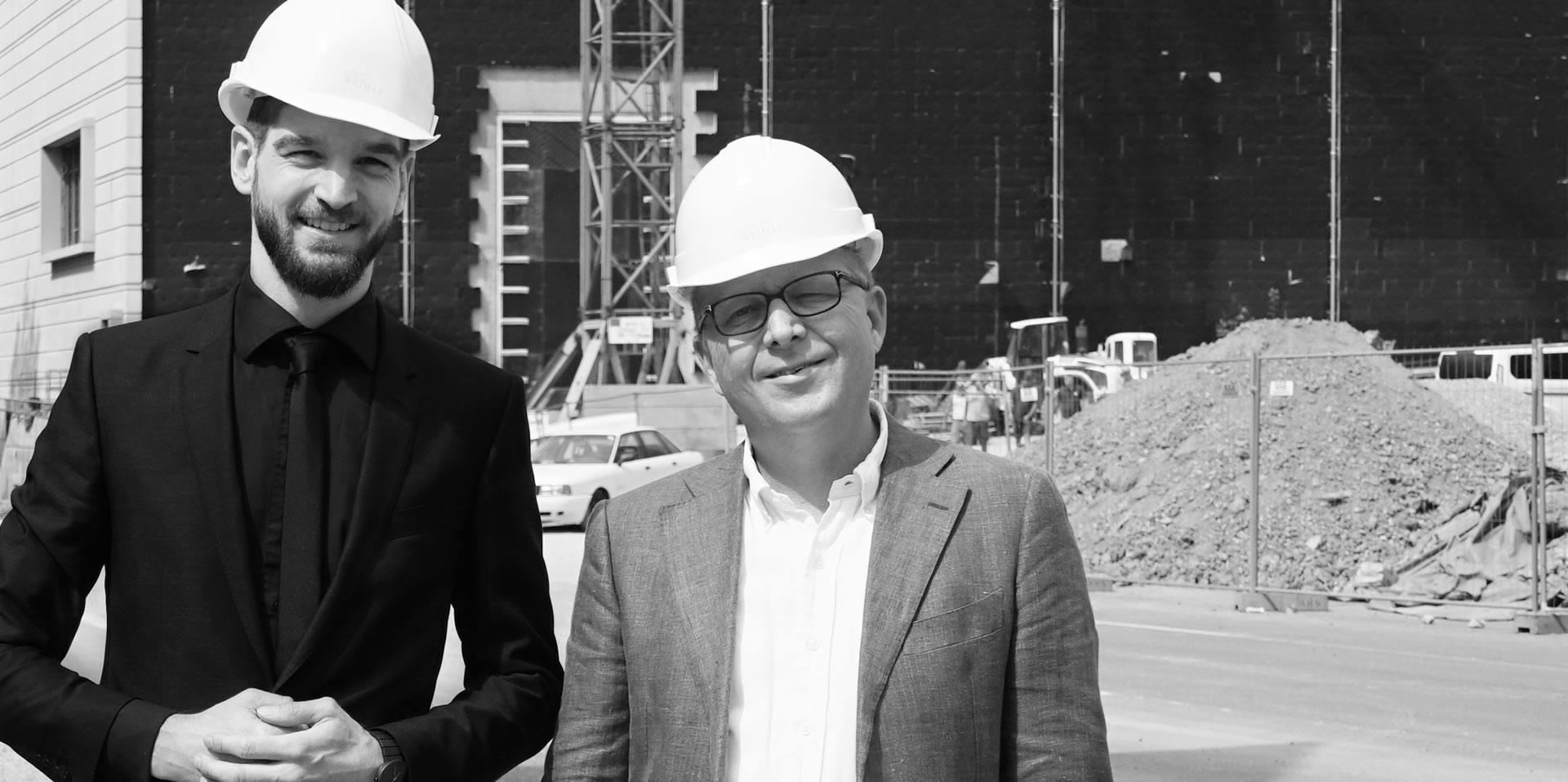
Construction Begins
Bauhaus Museum Store, Weimar
Following the completion of the design phase, construction began on the implementation of the design developed by Felix Schwake for the museum store of the Bauhaus Museum Weimar.
The project was based on a spatial programme developed in collaboration with Alexander von Keyserlingk. As managing director of the museum store of the Klassik Stiftung Weimar, as well as an author and expert in urban retail concepts, he was particularly concerned with questions of flexible and long-term usable retail and exhibition structures.
The architectural design translated these requirements into a modular spatial system. At its core was the idea of movable presentation elements organised as a fully flexible system. All modules could be reconfigured freely in order to enable changing spatial situations and different forms of product presentation.
The design was not conceived as decorative retail architecture. Instead, the focus was on developing a calm spatial order that allows change without losing its atmospheric clarity. Architecture was intended not to operate through permanent visual stimulation, but through structure, materiality, and proportion.
The mobile elements enabled continuous spatial transformation of the museum store without requiring elaborate re-staging of individual product displays. This resulted in a system that combines flexibility with spatial calmness.
The project therefore connects directly to key questions already raised by the historical Bauhaus: How can function, construction, and use become an immediate part of design? And how can spaces be developed that remain usable over time without losing their design clarity?
The implementation of the project also reflects an attitude towards architecture and interior design that does not understand design as a static image, but as a spatial structure capable of responding to use, change, and human perception.