
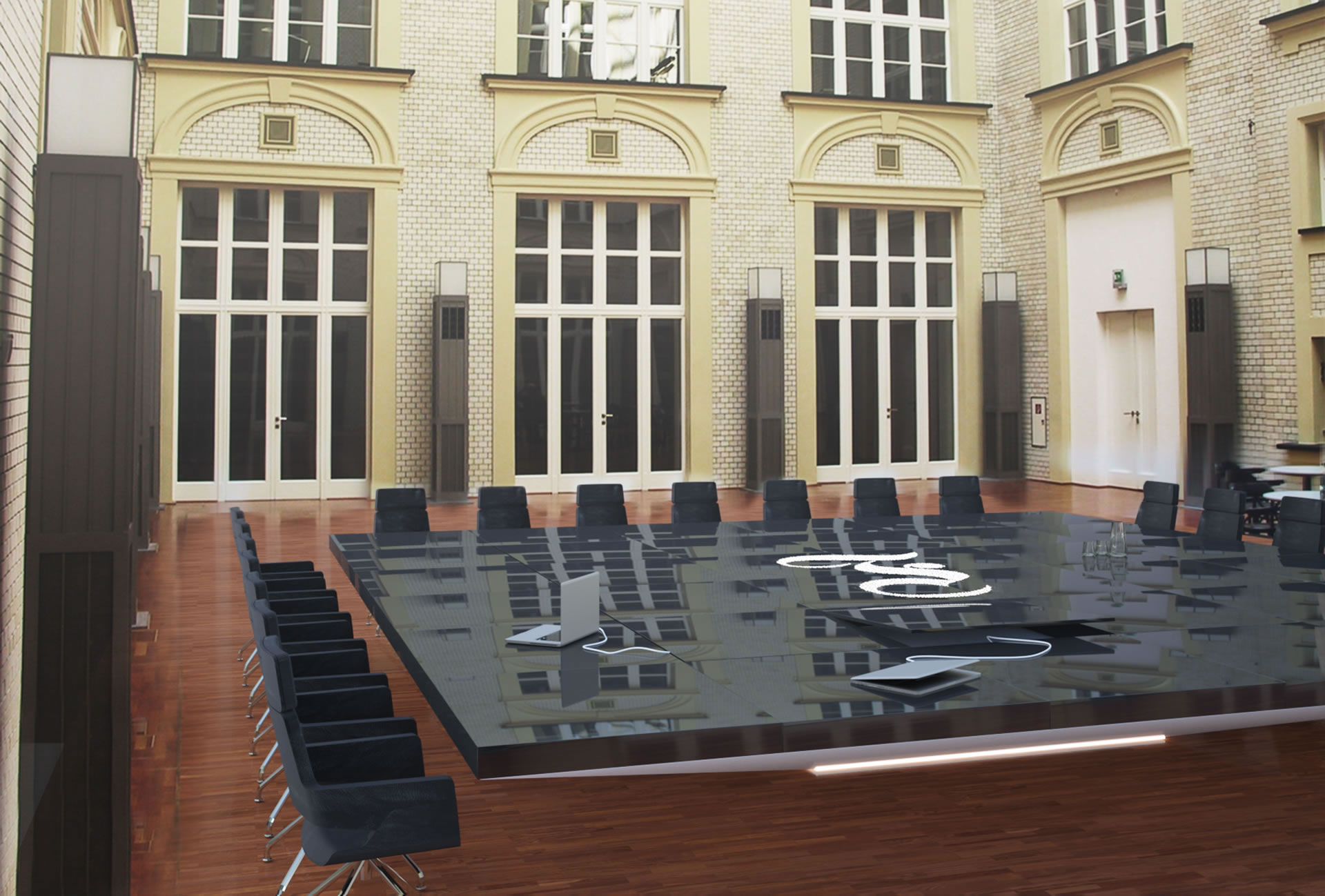
Conference Table (FAZ, Frankfurter Allgemeine Zeitung)
“We want the most extraordinary conference table in Germany”
For the Frankfurter Allgemeine Zeitung (FAZ), Felix Schwake developed a conference table concept that fundamentally questioned the conventional understanding of meeting spaces. The project originated from an unusually open brief issued by the FAZ marketing department: the goal was to create “the most extraordinary conference table in Germany” — an object unlike anything previously realized in this form.
Felix Schwake responded to this task not through decorative staging, but through a radically reduced formal gesture. The design follows an extremely purist linear language and derives its impact precisely from its geometric clarity. The form is reduced to such an extent that it acquires an almost symbolic presence and begins to structure the space itself.
At the center of the project, however, is not merely the external form, but the transformation of the conference table into an interactive medium of communication. The square tabletop was conceived as a fully integrated touchscreen display measuring approximately 6 × 6 meters. Presentation content could be transferred directly from wall surfaces onto the tabletop, edited there, and collaboratively developed further.
In this way, the classical model of presentation as one-directional information delivery is dissolved. Instead, a dynamic working process emerges in which content can be modified, expanded, and reorganized directly during discussion. Information can be assigned to individual participants through gestures or shifted between different working zones.
The table thereby becomes more than furniture or a technological surface; it becomes a spatial instrument for collective collaboration.
The project exemplifies Felix Schwake’s approach to the relationship between architecture, function, and technology: technology should not dominate visually, but instead be fully integrated into a clear spatial order. Technical innovation does not appear as an end in itself, but serves concentration, communication, and interaction.
The reduced geometric form consciously creates a calm background for what remains essential — the shared work and exchange between users.
The FAZ conference table therefore became less a conventional piece of furniture and more an architectural communication system that reinterprets the spatial and technological nature of collaboration itself.