
Winner
German Design Award 2016
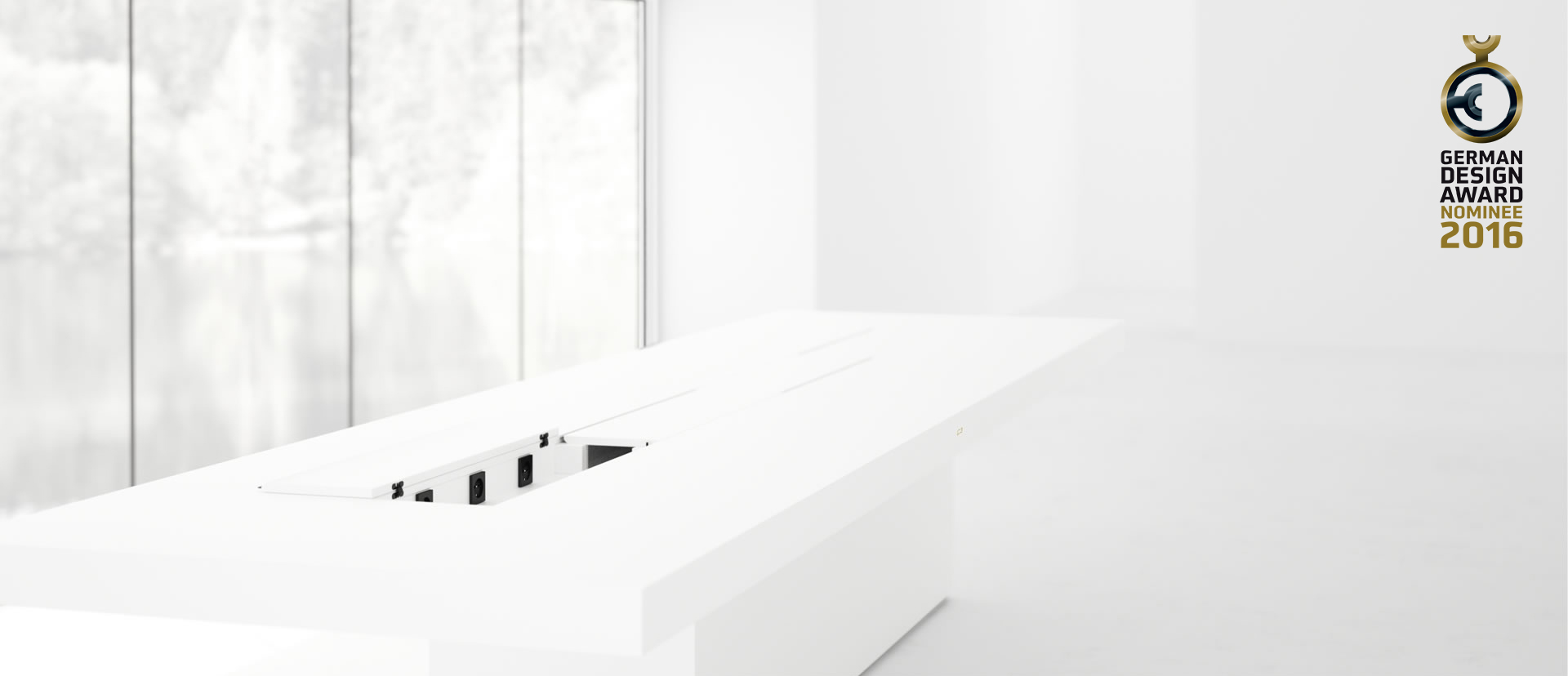
The Conference Table was nominated for the German Design Award in 2016. The project exemplifies a design approach that understands architecture, function, and spatial clarity as an inseparable unity.
The design follows a consistently reduced geometric order. Technical requirements and complex functions are fully integrated into the construction so that the visual calmness of the table remains intact even during everyday use.
Within the interior of the conference table are a wide cable channel and various media interfaces for power, network, fiber optics, USB, and HDMI. All technical elements remain invisibly organized while still being immediately accessible. The technical infrastructure therefore recedes spatially without limiting its functionality.
The project deliberately avoids the visual staging of technical equipment. Instead, its focus lies in the development of concentrated atmospheres for work and conversation in which architecture remains a background for communication and collaboration.
Even the tool-free assembly follows this principle. Construction and use are not understood separately, but as part of a precise architectural order.
Each conference table is developed as an individual custom-made piece. Proportions, materials, and technical equipment are tailored to the requirements of the specific project and its architectural context. Design is therefore not understood as standardized product development, but as a long-term spatial solution.
Materiality and craftsmanship are of central importance within the project. Surfaces, light, and proportions influence the perception of the object just as much as its use. The table is not understood as an isolated individual object, but as part of a larger spatial atmosphere.
The nomination for the German Design Award particularly recognized this connection between reduced design, technical integration, and enduring spatial quality.
The work of Felix Schwake consciously positions itself between architecture, interior design, and functional art. Design is understood not as a short-lived visual appearance, but as a lasting spatial experience within everyday life.