Digitality, technology, epistemic shifts
Univ.-Prof. Dr. phil. Vera Bühlmann (TU Wien)
Original language: German. The English version was translated using AI.
Prof. Dr. Vera Bühlmann
TU Wien
17 June 2026 · 11:00
Symposium “Designing. AI and other cultural protagonists.” · AMD Düsseldorf.
Today, the figure of the guardian is beginning to double in a peculiar way. On the one hand, AI systems increasingly appear as prosthetic guardians of subjects relieved of fatigue: they organise attention, anticipate decisions, smooth out complexity and take over the work of orientation that once required the capacity for judgment, memory or experience. The danger lies not only in control, but in a gradual loss of familiarity with the very capacity to engage with the world—a reduction of designing to navigation through possibilities that have already been computed. On the other hand, precisely for this reason, the older figure of the Daedalian Custos appears anew: the architect, generalist or intellectual as guardian of the habitability of the world. Not as a sovereign master, but as a guardian in a more original sense—one who protects transitions, keeps spaces of articulation open and prevents the world from disintegrating either into illegible complexity or into fully administered transparency.
The Daedali opera designate neither works of a sovereign subject nor properties of stable objects, but forms of a circulating intellect embodied in articulations, transitions and modes of proceeding. The Daedalian is not an interiority that communicates itself expressively outwards, but a metis: a resourceful, operative intelligence that does not possess but navigates, does not rule but opens paths through complex situations. As something born of the intellect, it is peculiarly impossible to locate—neither merely individual nor entirely collective, neither purely technical nor purely symbolic. Its style therefore lies not in a subjective signature or personal expression, but in the way relations are folded, movements guided and orientations made possible. At the same time, the Daedalian makes no claim to objective totality or definitive decorum: it does not order the world from an absolute perspective, but always articulates situated habitability within an interminable labyrinth of conditions. Its measure is not truth as an overview, but traversability as an ethical and technical art.
In a Daedalian sense, architecture is custodial when it not only organises use, but sustains the possibility of orientation in our relations to the world.
The Custos is responsible for the ethics of passage.
The art of the Custos consists in folding complexity so that it gives rise to experience rather than mere overload.
The Daedalian Custos protects the distinction between orientation and control.
Where everything is expected to become immediately legible, the Custos defends the world’s right to depth.
Where everything threatens to become difficult to grasp, the Custos defends the possibility of coherence.
The Custos is not a sovereign of space, but the guardian of its capacity for articulation.
The Custos does not merely build buildings; the Custos cultivates ecological conditions of understanding.
The Daedalian Custos knows that every architecture distributes attention, uncertainty, proximity and distance—and bears responsibility for doing so.
The Custos protects the fragile balance between excessive complexity and simplification.
The responsibility of the Custos concerns not the object alone, but the movements that an object enables or prevents.
The Daedalian Custos does not design total transparency, but articulates zones of graduated legibility.
The Custos ensures that the world may offer resistance without becoming inaccessible.
From the text Univ.-Prof. Dr. phil. Vera Bühlmann prepared for the symposium. Translated from German.
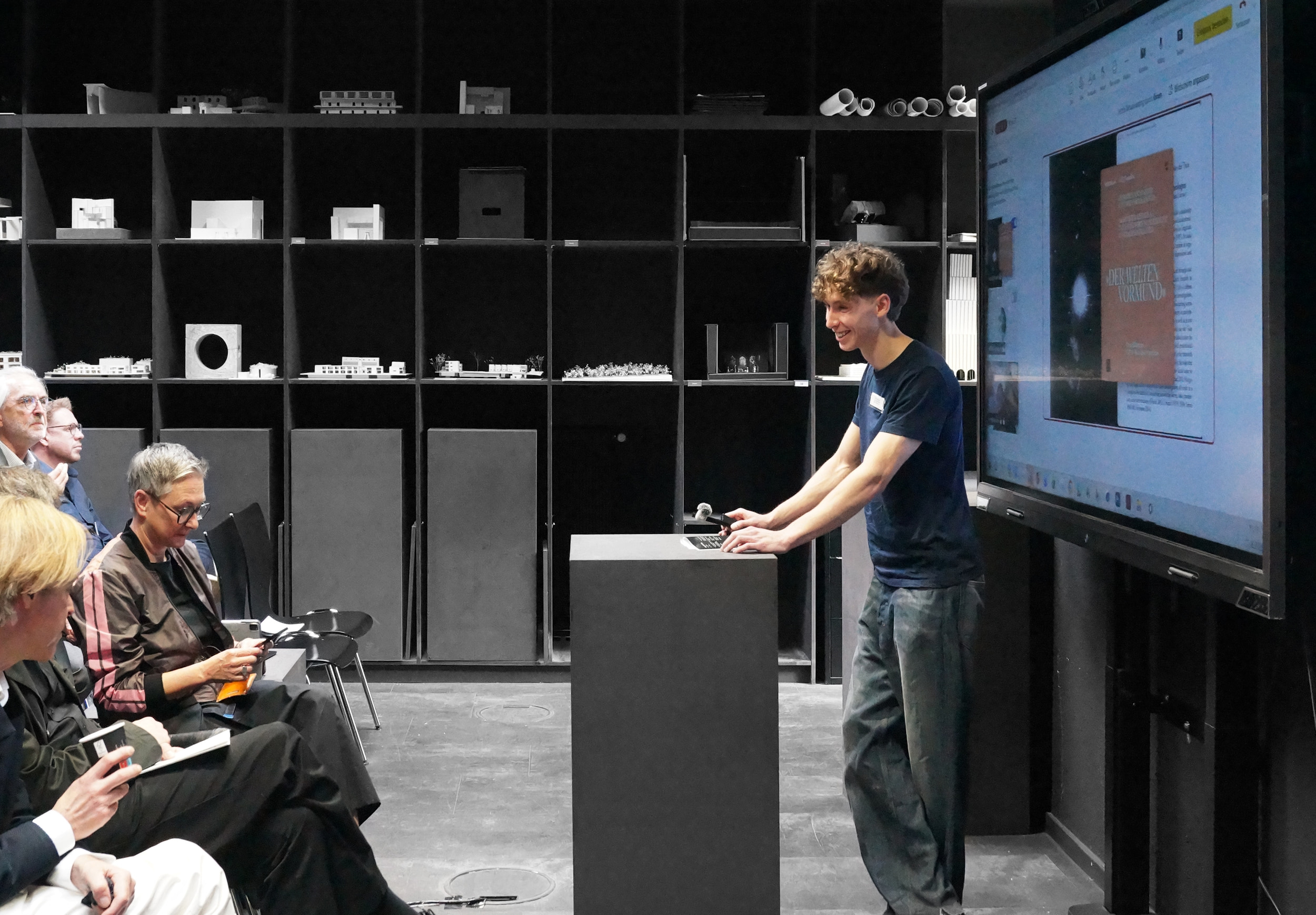
“Would you like to add anything on this subject?” Responding to this explicit invitation from the moderator, Ms Bühlmann adds a cultural and philosophical dimension to the discussion of AI. She welcomes its placement within longer histories of technological change. At the same time, she describes the scale of the transformation through an analogy with the introduction of zero and the associated reorganisation of knowledge and social relations.
For architectural theory, this brings the relationship between technology, art and knowledge into focus. Ms Bühlmann emphasises forms of thinking about designing and architectonics that work through abstraction. Her answer extends the question developed in her lecture: how can different orders of knowledge enter into relations that open further possibilities for thought?
Optimism becomes a demanding intellectual activity in this account. Alongside necessary criticism, it calls for the construction of possible scenarios and the development of forms through which to explore them. Ms Bühlmann assigns universities a public responsibility in this process: to provide time for inquiry without requiring every line of thought to arrive immediately at a usable solution. Ms Bühlmann thus connects technological change with the question of what freedom research and design education need.
Selected thoughts and contributions from Discussion I – Theory and foundations at 12:00. Quotations translated from German.